

 LinkedIn
Is Answer Engine Optimization just SEO with a more expensive acronym? Smart operators disagree because clean pages, authority, and useful content still matter, but a page that ranks on Google can fail to reach an AI answer engine. My verdict: roughly 70% of the work overlaps, and the remaining 30% is where businesses lose citations without noticing.
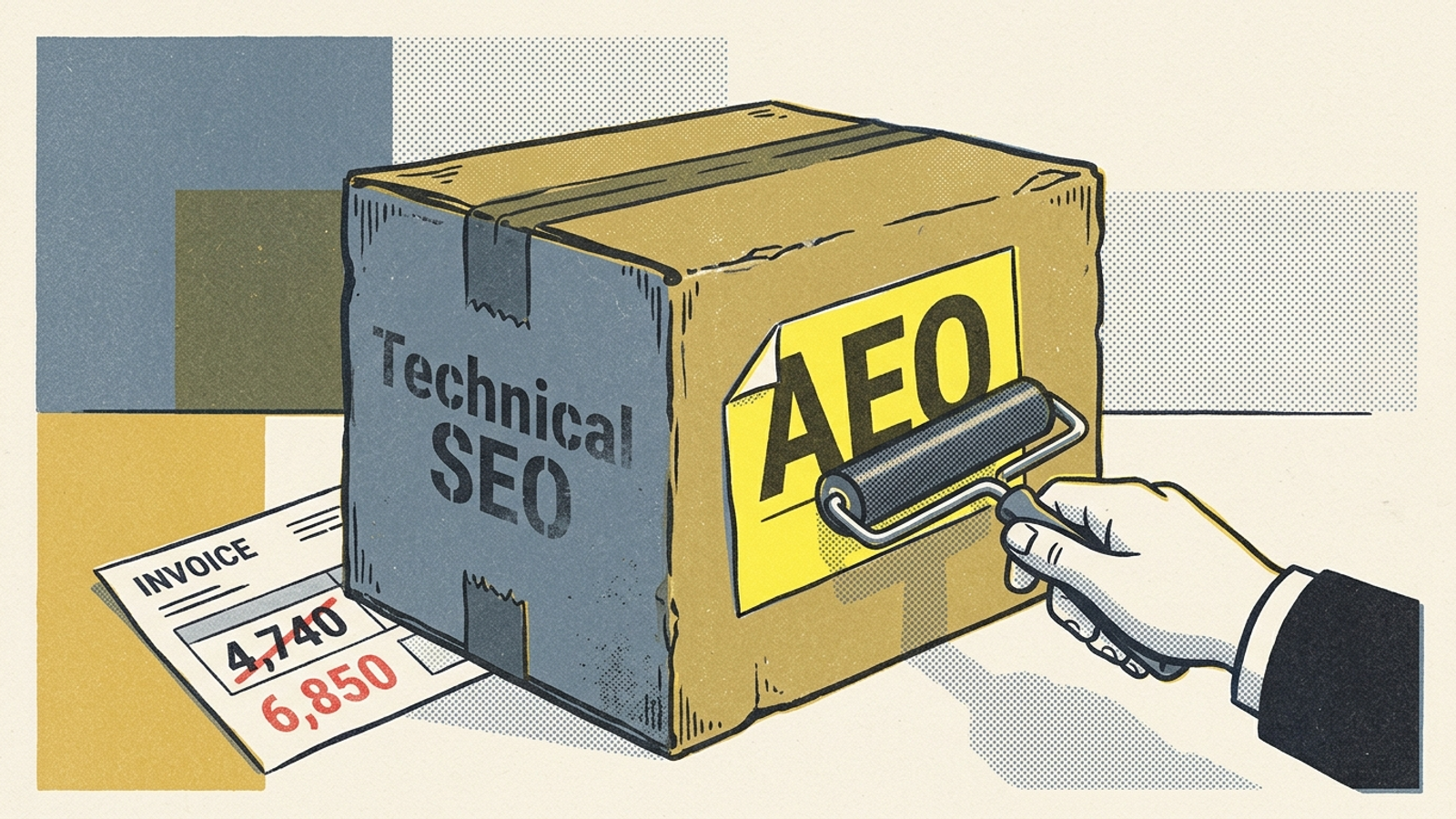
The price of getting that distinction wrong is real. According to First Page Sage’s analysis of over 1,100 agency quotes, the median monthly AEO retainer is $6,850, versus $4,740 for traditional SEO. That is a 45% difference. A business owner has two reasonable objections: Why pay twice for work an SEO provider should already do? And why assume Google rankings are enough when customers increasingly encounter answers assembled elsewhere?
I would not sign a second statement of work until those questions have separate answers. First, the best case for the people who call AEO a relabelled retainer. Then, the best case for the people who say AI citation requires different work. Only after that does the invoice deserve a verdict.
Position A: Most AEO work is SEO with a new label
The strongest argument for Position A starts with the page itself. An answer engine still needs material it can find, parse, and trust. Clean HTML, quick responses, sensible structure, and topical depth do not become obsolete because the interface shows a generated answer instead of ten blue links. Much of the work sold as AEO improves search visibility for the same reason it always did: it makes a useful page easier to discover and understand.
As Roger Montti pointed out in Search Engine Journal, tactics such as direct answers beneath clear headings, well-structured tables, and JSON-LD schema did not appear with generative search. They were standard practice in the Featured Snippet era. Calling an oil change a propulsion overhaul does not make it a second service.
Authority still has to be earned
The SEO camp’s next point is harder to dismiss: an answer engine cannot cite a brand it never encounters or has no reason to trust. Search indexes help retrieval systems find candidate pages. Editorial links, mentions in industry publications, and a substantial body of relevant content can help establish why a page belongs among those candidates. None of that comes from finding the right phrase to insert into a prompt.
This is the unglamorous part agencies sometimes try to sell twice. A thin site does not acquire a genuine industry footprint by renaming its content calendar an answer architecture. If your pages lack substance and outside recognition, fixing that foundation matters more than commissioning a new acronym. Keep paying for the hard authority work, but pay for it once.
The retainer is where the suspicion gets teeth
Practitioners in communities such as r/MarketingandAI argue that much of an AEO scope resembles an existing SEO scope with changed labels. Keyword mapping becomes intent cluster mapping. FAQ schema becomes knowledge graph injection. Content pruning becomes hallucination prevention. The names sound expensive. The tasks sound familiar.
That does not prove every AEO contract is wasteful. It gives a buyer a precise objection: if the deliverables are clear headings, schema, topical coverage, and technical hygiene, why are they absent from the SEO agreement already in force? The Position A advocate does not need to claim that AI answers are identical to Google results. The narrower claim is strong enough: a new destination does not justify rebilling the same journey.
Position B: AI citation exposes gaps that rankings can hide
Position B begins at the point where a good Google ranking stops being a guarantee of anything else. A search result can present your page as one option. An AI answer pulls material from retrieved sources and assembles a response. In that process, access to the page, access to the relevant passage, and support from other sources can matter independently of where your URL sits in a familiar results list.
This side’s best argument is not that SEO fundamentals have stopped working. It is that an SEO report can look healthy while the route from your page to an AI citation is broken. Three gaps deserve particular attention.
First, the bot has to reach the page
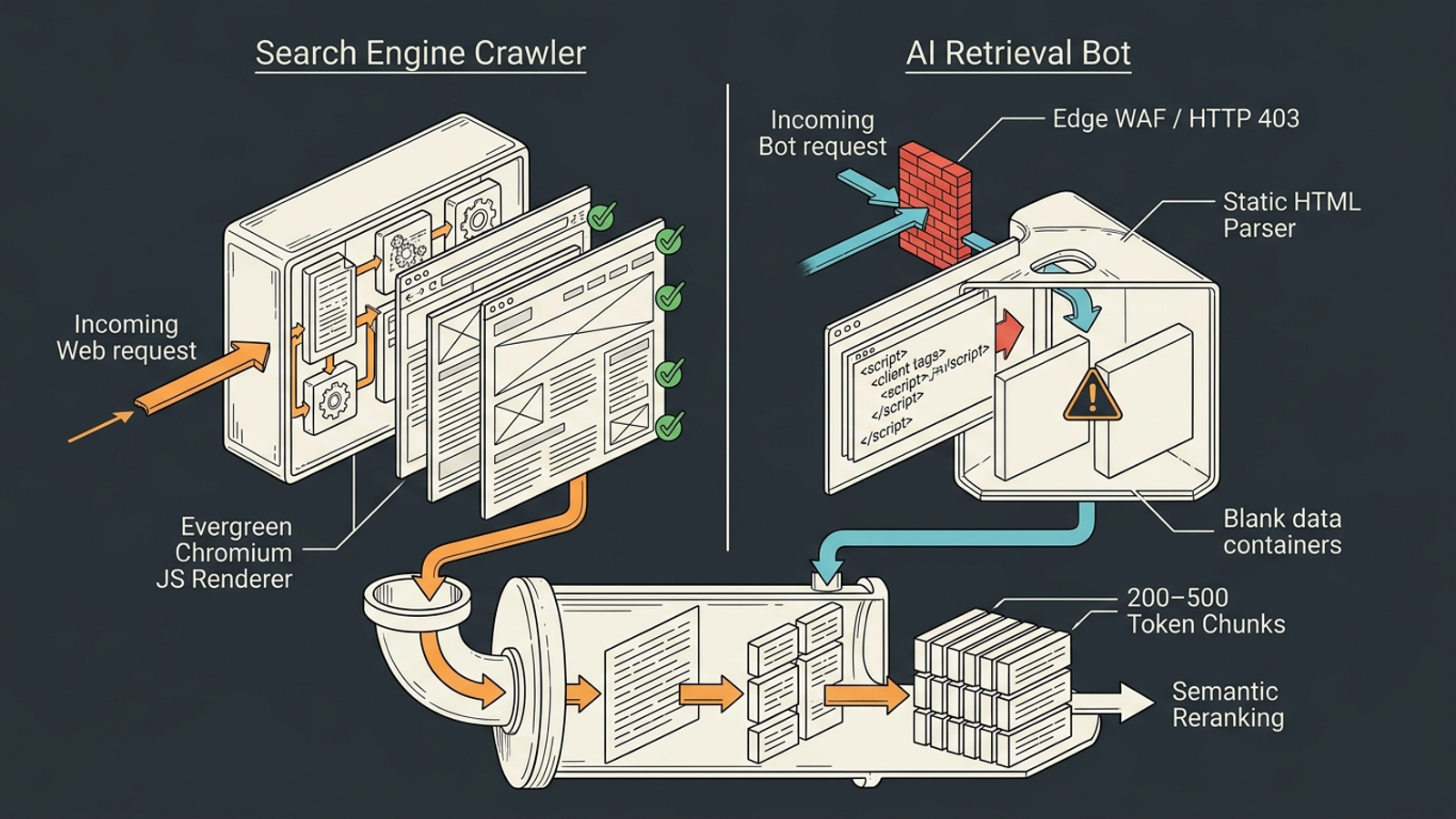
Googlebot access does not establish AI bot access. OpenAI’s crawler documentation distinguishes GPTBot, used for training-related crawling, from OAI-SearchBot and ChatGPT-User, which serve different search and user-request purposes. A team trying to limit training access needs to know which user-agent its rule actually affects. A blanket block can also keep a bot needed for live discovery or retrieval away from the site.
The refusal may happen before a bot even reaches robots.txt. As Cloudflare’s discussion of mixed-use AI crawlers illustrates, edge protections complicate crawler access. A firewall challenge or HTTP 403 response can stop a request at the perimeter. Your Google rankings will not tell you whether that happened to an AI bot; server and edge logs might.
This is the cleanest answer to the just SEO argument. A provider can be excellent at Google crawlability and still fail to check a different user-agent at a different gate. Ask for the status codes, not a slide about crawl health.
Second, the answer has to survive extraction
Getting through the gate is only the beginning. Googlebot can render client-side JavaScript before indexing. A lightweight retrieval fetcher may instead depend on the HTML it receives. If essential product details, pricing, or proof exist only after a script runs, that fetcher may miss them. A page can therefore look complete in a browser and still offer little useful text to a system extracting an answer.
The problem also appears inside readable pages. As Lumar’s explanation of content chunking describes, retrieval pipelines can work with passages rather than an article as one uninterrupted argument. Its example chunks run around 200 to 500 tokens, or roughly 150 to 375 words. If the answer to a buyer’s question sits five paragraphs away from the heading that names the question, a relevant passage is harder to isolate.
The fix is not to turn every article into a warehouse of robotic FAQs. Put the answer near the question. Use headings that say what the next section delivers. Keep the supporting detail beside the claim it supports. Traditional SEO may benefit too, which is precisely why this debate is not a clean split. For AI retrieval, though, passage-level clarity can decide whether useful copy gets used at all.
Third, your own page may not settle the claim
A top-ranking product page makes a strong case for a click. An answer engine assembling a recommendation may also look for corroboration beyond the company making the claim. Independent reviews, trade discussions, publications, and other off-site mentions can become part of the answer’s source mix. On-site copy alone cannot supply that outside view.
The studies cited in this debate point in the same practical direction. A 5W Public Relations analysis of AI answers reported falling overlap between Google’s top-ten results and cited AI sources. Ahrefs likewise found that top-ten organic results accounted for 38% of the AI Overview citations it examined. Those figures do not tell you which publication to pitch or which forum to join. They do challenge the assumption that owning the ranking means owning the citation.
Position B’s practical case is now complete: make the page reachable, make its answers extractable, and give other sources a reason to substantiate what it says. A conventional rankings report checks none of those three things by itself.
Where the two pitches fall apart
Now for the rebuttals. The AEO is just SEO pitch is weakest when it treats a first-page ranking as proof that every retrieval path works. A team can do solid authority-building work and still miss an edge rule returning 403s to an AI bot. It can watch Google index a rendered page while overlooking how little product information exists in its raw HTML. Dismissing those differences because the fix involves a website is a neat way to avoid inspecting the website.
The AEO is an entirely new game pitch has the opposite problem. To justify a separate retainer, it can pretend that authority, technical hygiene, and useful content no longer count. Then come the proprietary visibility score, the prompt trick, and the deck that gives a familiar task a more expensive name. The measure-first-or-fix-first debate matters here: paying for a monitoring dashboard before fixing an obvious access problem is an odd order of operations. If nobody can show you what changed on the site or at the edge, a rising mention count is not much of an answer.
Neither sales pitch survives contact with the whole workflow. Foundational SEO earns a page its place; AI-specific checks test whether that place can turn into a citation. Confuse the two, and you either pay twice for maintenance or leave a quiet failure unexamined.
My verdict: pay for the 70% once, then inspect the missing 30%
I take the 70/30 side. That is my working judgment about the scope of the work, not a measurement to put on a contract. Roughly 70% is the foundation a competent SEO operation should already provide: topical coverage, useful structure, schema where it belongs, responsive pages, and authority earned beyond your own site. If an AEO proposal mainly promises those things, ask why the existing provider has not delivered them. Do not buy a second engine because somebody painted express lane on the road.
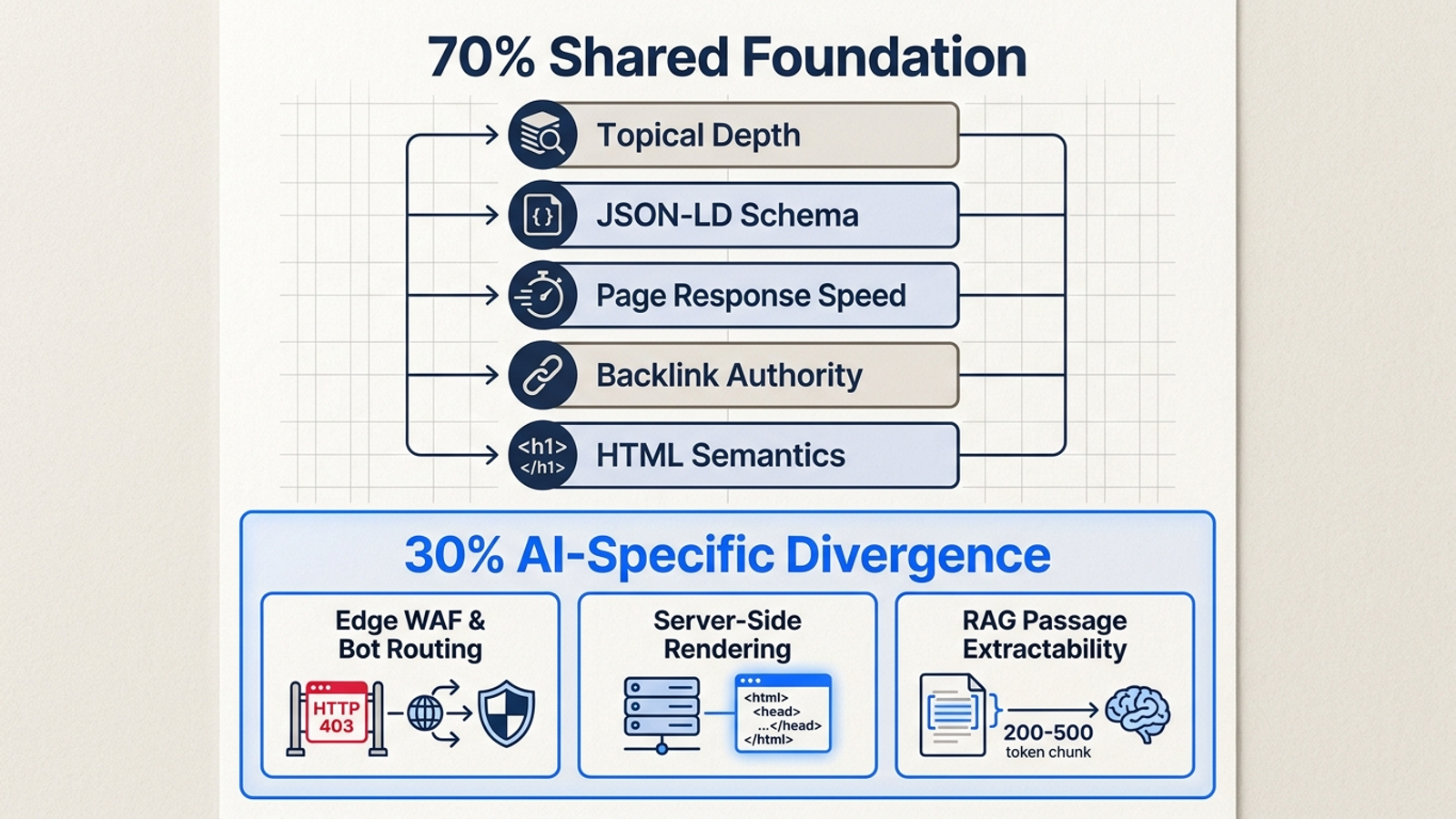
The remaining 30% is decisive for the business with solid rankings but little presence in AI answers. Check whether relevant bots can reach the site. Check whether essential answers appear in retrievable HTML and coherent passages. Check whether important claims have an off-site footprint. The first two are especially easy to miss in ordinary SEO reporting; the third cannot be manufactured by polishing a product page.
The single consideration that decides it for me is the invisible failure: a page can perform in Google while an edge block or extraction problem prevents its content from being available to an AI answer. That is a different diagnostic job. It deserves an owner and a fix, not necessarily a second standing retainer.
For a business choosing an operating model, the distinction matters. A monthly review can discuss a crawler block after someone notices missing citations; it cannot catch the block as it happens. At groas, the alternative to agency hours is continuous execution across paid and organic search, with autonomous work on campaigns, bids, targeting, budgets, content, and optimisation under a named human strategist’s direction. That model is a better fit than paying an agency for another deck about visibility. An edge configuration still needs to be checked and addressed by whoever controls it. The point is to make the failure visible and accountable, rather than wait for the next meeting.
Three questions to put to your SEO provider tomorrow
Before accepting an AEO add-on, ask for evidence of work that differs from the SEO work you already buy. These questions move the conversation from terminology to a diagnosable page:
- Can you show me the server or edge-log status codes for
OAI-SearchBotandPerplexityBotover the past 30 days? Google Search Console is not an answer to a question about those user-agents. You want to know whether their requests reached the site or met a block or challenge. - Are our core product details, pricing, and proof present in the raw HTML, or do they depend on client-side JavaScript? A browser screenshot shows what a person sees after rendering. It does not settle what a lightweight fetcher can extract.
- Which deliverables in this AEO proposal are not already part of our technical SEO agreement? Clear headings, schema, and topical coverage may be valuable. That does not make them new. Ask who will inspect bot access and extraction, what they will change, and how they will confirm the result.
If the answers are vague assurances about conversational intent, decline the add-on. If they identify a real access or extraction problem, fix that problem with a clear owner and a way to verify the change. Those are different outcomes, and the invoice should reflect the difference.
Stop buying acronyms to solve execution problems. Keep the SEO work that earns trust. Then check the 30% that can make an otherwise credible page disappear from AI answers. Pay for the failure to be found and fixed, not for its new name.